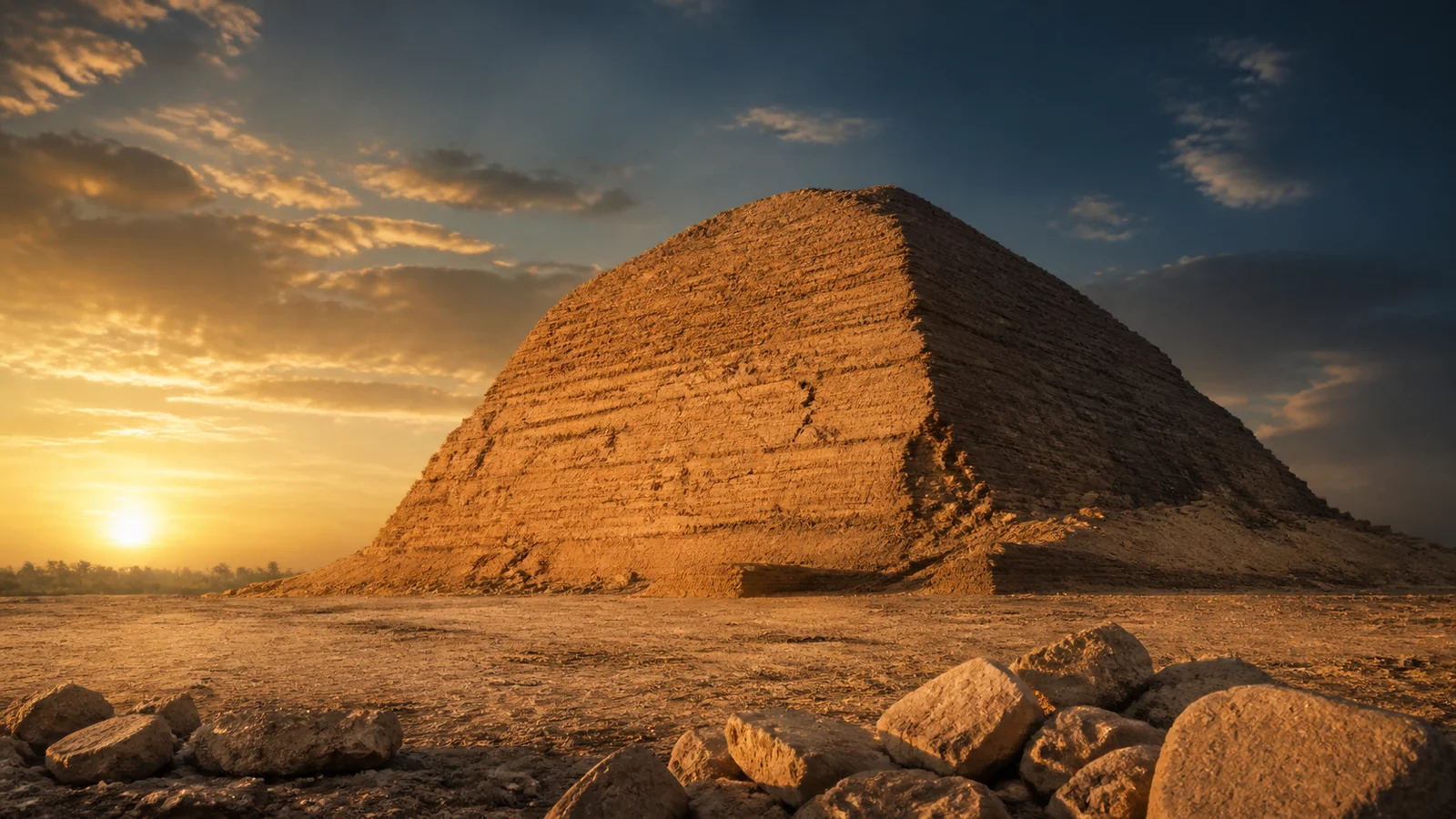
After years of denials, the Hawara labyrinth is being excavated.
In May 2026, Egypt’s Ministry of Tourism and Antiquities confirmed new fieldwork at Hawara in the Fayum. By summer, footage from the trench showed megalithic walls coming out of the sand — beside the ruined pyramid of Amenemhat III, on the same footprint later scans had marked.
That is the verified shift. Not a finished discovery. Not a closed case.
The lost labyrinth of Egypt was supposed to be gone. Petrie said so in 1888. For more than a century the public line followed him: a mudbrick pyramid, scattered stone, no 3,000-room complex.
The ground is open again. Structures are already visible. What still sits deeper — including a scanned metallic object at the centre of the plan — has not been reached.
Where is the Hawara labyrinth?
Hawara (also written Hawwara) sits at the entrance to the Fayum Oasis, roughly 80–90 km south of the Giza Plateau, beside the Bahr Wahbi canal.
The landmark on the surface is the Hawara pyramid: the eroded mudbrick core of the pyramid built by Amenemhat III, a 12th Dynasty king who ruled around 1860–1814 BC. Ancient writers placed a vast building next to a pyramid in this same landscape — a little beyond Lake Moeris, near the City of Crocodiles (ancient Shedet / Crocodilopolis).
That pairing is why Hawara, not Giza, is the site now being dug for the labyrinth.
What Herodotus wrote about the labyrinth of Egypt
The core ancient account is Herodotus, Histories 2.148, written after a visit around 450 BC.
He said he had seen the building himself. He said it surpassed even the pyramids. He described:
- twelve roofed courts with facing gates — six north, six south — inside one outer wall
- two levels of chambers: about 3,000 rooms in total, 1,500 above and 1,500 below
- stone roofs, carved walls, courts ringed with fitted white-stone pillars
- a pyramid standing near the corner where the labyrinth ended, with an underground passage toward it
He walked the upper level. He was refused the lower level. The Egyptian priests told him those sealed chambers held the burial vaults of the kings who first built the labyrinth — and of the sacred crocodiles.
That last sentence is the part later writers keep returning to. Amenemhat III raised a pyramid at Hawara more than a thousand years before Herodotus arrived. The priests were not describing that king as the original builder. They were describing something already there.
Herodotus was not the only ancient source. Strabo, who visited Egypt in the late first century BC, called the labyrinth a work equal to the pyramids and placed it with the pyramid in a trapezium of ground. Diodorus, Pliny, and Manetho’s tradition also describe a vast complex at this horizon. Their details differ. The location and the scale do not collapse.
Why Petrie thought the Hawara labyrinth was gone
Karl Lepsius mapped Hawara in the 1840s. Flinders Petrie excavated in 1888–89.
Petrie found the mudbrick pyramid, Roman-period mummy portraits in the northern cemetery, and stone scatter across the so-called labyrinth site. He did not find a standing palace of 3,000 rooms. The working explanation that followed was quarrying: Ptolemaic and later builders stripped the fine limestone and hauled it away, leaving the brick core of the pyramid and almost nothing of the temple-labyrinth.
That explanation is still the mainstream reconstruction of the surface.
It leaves a timing problem. Herodotus counted rooms. Strabo wrote about the layout. Pliny wrote about light in the upper chambers. Those are observations of a building you can walk through. If the structure was already rubble in 450 BC, those observations do not work. Whatever stripped the monument happened after the ancient visits — or the lower mass was never on the surface Petrie cleared.
Hawara labyrinth scans: walls under the sand
The modern second chapter starts with scanning, not with a trench.
In 2008 the Mataha expedition — Louis De Cordier working with Egypt’s National Research Institute of Astronomy and Geophysics and Ghent University — ran ground-penetrating radar and electromagnetic survey at Hawara under official permit. At about 8–12 metres they reported vertical walls and room-like spaces across a wide rectangle, on the ground ancient writers assign to the labyrinth. A large horizontal stone feature Petrie had treated as a destroyed foundation read, in that dataset, more like a ceiling.
The team presented at Ghent. Communication about the results was then restricted. De Cordier later published the material himself.
In 2015, satellite imaging associated with Merlin Burrows and analyst Tim Akers covered the same site under a ten-year non-disclosure agreement that expired in 2025. That work described a large rectangular mass consistent with the 2008 footprint, multiple suggested levels, and a central hall.
Later survey teams — including Polish and Egyptian university work, and planned follow-on scans — have reported anomalies in the same area. Four separate methods do not prove a 3,000-room palace. They do keep returning the same buried outline beside the Hawara pyramid.
The metallic object at Hawara
This is the claim that travels fastest. It should be stated exactly.
In the 2015 satellite-scan interpretation, a large anomaly sits at the centre of the mapped complex: on the order of 40 metres, reading as metallic rather than stone or wood, inside what looks like a purpose-built chamber or atrium.
It has a nickname in that literature — “Dippy.” It has been compared to a disc, a shen-ring, a tic-tac form. Some researchers have pointed at ancient Egyptian language about a circular sacred object at the heart of a complex. None of that is an excavation find.
The metallic object at Hawara has not been dug. It has not been sampled. It has not been photographed in a trench.
It is a scan signature. Until a team reaches that depth and puts eyes on the source of the signal, it remains an open question — the most viral question on the site, and the least verified.
Hawara excavation 2026: what has actually been found
On 7 May 2026, Egypt’s Ministry of Tourism and Antiquities confirmed new fieldwork at Hawara. Published notices name an Egyptian-led mission under Fayoum antiquities, with Ashraf Sobhi (Director General of Fayoum Antiquities) associated with the work.
The brief is to locate and document surviving remains of the so-called Palace of the Labyrinth beside the pyramid, against rising groundwater that has long blocked deep work.
By June and July 2026, visitors with access to the trench — including footage circulated by Mohamed Ibrahim and later site updates — showed:
- megalithic walling coming out of the sand
- large worked stones at depth
- fragments that look like pillar pieces
Those stones sit beside the Hawara pyramid, on the scanned footprint, after years in which the public line was that nothing significant remained.
That is the news. A wall is not the whole labyrinth. Early trenches are not the sealed lower level Herodotus was denied. The 2026 excavation has not announced the metallic object.
It has announced that the ground is no longer closed, and that architecture is already in daylight.
Pyramid, labyrinth, and the question that is still sealed
Three facts can sit next to each other without a verdict.
- Amenemhat III built a pyramid at Hawara in the Middle Kingdom. That pyramid still marks the site.
- Ancient writers described a labyrinth next to a pyramid here as greater than the pyramids, with a sealed lower level the priests would not open.
- Scans mapped a large buried mass on that ground; 2026 excavation has begun exposing walls; a central metallic anomaly remains unexcavated.
The priests’ line is the one that keeps the mystery intact. They did not tell Herodotus that Amenemhat III was the first builder. They told him the underground held the kings who built the place originally.
If the 2026 mission stops at the first megalithic wall, the story stays a ruined pyramid with a new trench.
If it reaches the depth the scans mark — and the chamber at the centre — the questions change.
Who built the first layer?
What was sealed even to Herodotus?
What produces the metallic signature?
No answer belongs in this article yet. The Hawara labyrinth is being excavated. The pyramid is the landmark. The walls are the first layer. The object at the centre has not been touched.
Hawara labyrinth: quick facts
| Question | What is known so far |
|---|---|
| Where is the Hawara labyrinth? | Hawara, Fayum Oasis, Egypt — beside the pyramid of Amenemhat III |
| Who described it first in detail? | Herodotus, Histories 2.148, c. 450 BC |
| What did he claim? | A complex that surpassed the pyramids; ~3,000 rooms on two levels; lower level sealed |
| What did Petrie find in 1888? | Mudbrick pyramid core, stone scatter — not a standing 3,000-room building |
| What did 2008–2015 scans show? | Buried walls / a large rectangular mass on that footprint; a central ~40m metallic anomaly in one interpretation |
| What changed in 2026? | Official excavation confirmed 7 May 2026; megalithic walls already exposed |
| Has the metallic object been found? | No. It remains a scan signature, not an excavated artefact |
FAQ: Hawara labyrinth, pyramid, and the 2026 dig
Is the lost labyrinth of Egypt at Hawara?
Hawara is the site ancient topography and most modern research assign to Herodotus’ labyrinth: a pyramid at the corner of a vast court-and-chamber complex near Lake Moeris. That identification is old. Proof that the full two-level building still survives underground is what the 2026 excavation is testing.
What is the Hawara pyramid?
It is the pyramid of Amenemhat III (12th Dynasty). The fine limestone casing is gone. The mudbrick core remains. Ancient writers place the labyrinth next to this pyramid, with an underground passage toward it.
Did Egypt deny the Hawara labyrinth?
For years after the 2008 scans, the public position was that nothing significant matching the legendary labyrinth remained to be dug. In May 2026 the Ministry confirmed new fieldwork at the site. That is the reversal the current coverage is about.
Have archaeologists found the Hawara labyrinth in 2026?
They have found structures — megalithic walls and worked stone — in a new trench beside the pyramid. They have not published a complete labyrinth, a lower level of 1,500 rooms, or a named central object.
What is the metallic object under the Hawara labyrinth?
A ~40-metre anomaly in 2015 satellite-scan interpretation that reads metallic and sits in a central chamber-like space. It has not been excavated. Treat every firm identification as speculation until a trench reaches it.
Why was the underground section sealed?
Herodotus says the priests refused him entry and told him the vaults held the original builder-kings and the sacred crocodiles. That is a reported claim from 450 BC, not a modern find.
Can you visit the Hawara excavation?
Hawara is a known archaeological site in the Fayum. Access to the active trench is controlled by Egyptian antiquities. Surface views of the pyramid and the wider site remain the public face of the work.
Sources and further reading
- Herodotus, Histories 2.148 (Perseus / standard translations)
- Strabo, Geography 17.1.37
- W.M.F. Petrie, Hawara seasons 1888–89
- Mataha / NRIAG–Ghent geophysical work at Hawara, 2008
- Merlin Burrows / Tim Akers Hawara satellite scan material (NDA expired 2025)
- Egypt Ministry of Tourism and Antiquities notices on Hawara fieldwork, 7 May 2026
- On-site 2026 updates and trench footage circulated from Fayum antiquities access
This page will be updated as the Hawara labyrinth excavation publishes new official finds. Until then: walls are out. The pyramid stands. The metallic object is still a question.